

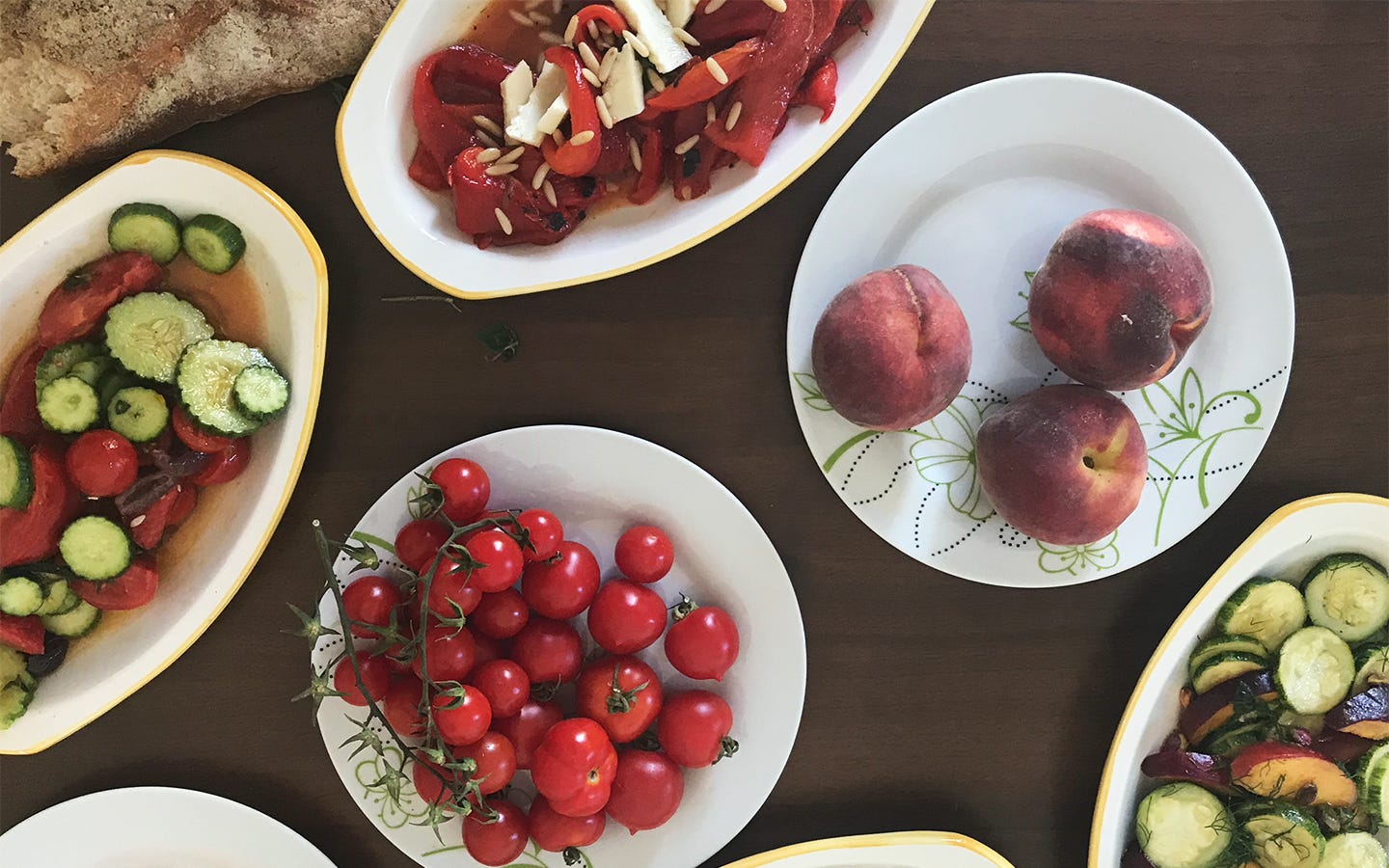
Yesterday, in the thick of the Fourth of July heat, I drove out to a local farm and came home with more vegetables than two people could reasonably eat. I laid them out on the counter, dressed them with nothing more than olive oil, a squeeze of lemon, and a little Maldon salt, and left them at room temperature. No ice. No stove. Just a table of cool, bright, ordinary food while the sidewalk outside shimmered.
I know how that sounds. It sounds like a mother wagging her finger in that nasally voice, eat your vegetables, while you stare down a plate of something gray and defeated. It's the least monetizable advice in wellness. You cannot build a best-selling book or an online course on it. There's no proprietary blend, no founder's origin story. Just vegetables, doing quietly what they've always done.
But I've spent more than twenty years watching women's bodies move through the heat of midlife — the literal heat and the hormonal kind — and I keep coming back to this humble, unglamorous strategy. So let me make the case for it the way I would in the treatment room. I think the vegetable might be the most elegant cooling medicine we have.
The thing everyone forgets about food
In Chinese medicine, we don't only ask what's in a food — the protein, the fiber, the vitamins. We ask what a food does to the body's internal climate. Every food carries an energetic nature. Some are warming; they stoke the fire inside us, which is wonderful in January and a problem in July. Others are cooling; they help the body shed heat rather than store it.
Most non-starchy vegetables are, by nature, cooling. Cucumber, leafy greens, celery, zucchini, summer squash, tomatoes. (Potatoes and sweet potatoes are the warming exceptions, but keep beets on the table; they're marvelous.) And here is the part that always makes me smile: these cooling foods happen to be exactly what's ripe and abundant right now. The earth grows the medicine we need in the season we need it. It always has.
Now, the piece most people get wrong.
Cooling does not mean cold.
When you drink an iced smoothie in a heat wave, your body has to spend real energy warming that frigid mass back up to its own internal temperature before it can digest a thing, and that effort, ironically, generates heat. In Chinese medicine we say cold food injures the digestion. The sweet spot isn't cold. It's room temperature.
Think of a midday feast in Sicily in the dead of summer: long tables of gorgeous fresh food, all served at room temperature. Nothing scalding, nothing icy. Just abundance in quiet balance with the weather outside. That instinct was refined over centuries in a hot climate, entirely without a single peer-reviewed study, and it is precisely what Chinese medicine would prescribe. The old cultures understood cooling long before we had a word like thermoregulation.
What the research quietly confirms
Here's where I love watching modern science catch up to something ancient.
The reason vegetables cool and protect us comes down, in part, to their phytonutrients — the polyphenols, flavonoids, and pigments that give a tomato its red and kale its deep green. These compounds are anti-inflammatory and antioxidant. They quiet the low-grade internal "heat" of inflammation that, in the Western frame, drives so much of how we age.
And the aging part is not a metaphor. In a study of more than 5,400 American adults, people who ate more fruits and vegetables had measurably longer telomeres — the protective caps on our chromosomes that fray as cells age. The difference between the highest and lowest vegetable eaters worked out to roughly four years of cellular aging. Four years, from something you can buy at a farm stand for the price of an iced coffee. And in that research, women's telomeres responded to both fruits and vegetables, while men's responded mainly to vegetables — our bodies seem especially tuned to what grows in the ground.
That same quieting of inflammation is likely why higher vegetable intake keeps turning up, study after study, alongside lower cancer risk — with the cruciferous family (broccoli, cabbage, kale, Brussels sprouts) looking especially protective, including for postmenopausal breast cancer. Let me be honest about what that means: these are associations, not cures, and no vegetable treats cancer. But it is an awfully consistent pattern for something you can toss with olive oil and lemon.
What I see across the table
The women who sit across from me in the clinic are, almost without exception, overwhelmed by conflicting advice. Keto, paleo, carnivore, fasting — each one louder than the last, each one promising to be the answer. When someone arrives frayed by all of it, I often tell her to put the noise down and start here, with the one recommendation the evidence never seems to walk back.
This matters even more in perimenopause and beyond. As estrogen declines, we lose some of the natural anti-inflammatory buffer we enjoyed in our younger years. The internal furnace so many women describe (the flushing, the 3 a.m. overheating) is real, and a spicy, boozy afternoon in the sun only pours fuel on it. Alcohol and spicy food both heat the system, energetically speaking. (Beer, oddly, tends to run a touch cooler than spirits. Make of that what you will.) A plate of cooling, room-temperature vegetables is one of the gentlest ways I know to help a body that's already running hot find its own thermostat again.
And yes — I adore a little sun for the vitamin D. But there's a wide gulf between a little sunshine and baking yourself to a crisp. Discernment, in the heat, is everything: knowing which pleasures cool you and which ones quietly cost you.
The invitation
You don't need a recipe so much as a principle. Fresh, seasonal, plant-forward, gently dressed, and not straight from the refrigerator. Let your sparkling water sit a few minutes before you drink it. Shave a cucumber, tear some greens, slice a tomato that actually tastes like a tomato, and let the plate come up to room temperature while you set the table.
That's it. That's the whole medicine.
If you want the fuller version — the specific foods, the research, the Chinese medicine reasoning laid out in one place — I wrote it all up in a detailed guide over on my site. And if the heat is doing more than making you sweat — wrecking your sleep, spiking your anxiety, turning your hot flashes up to eleven — I put together a companion heat-wave survival guide for exactly that.
But if you do nothing else this week, do the deeply unfashionable thing. Eat your vegetables. Not because your mother said so — because twenty years into caring for women's bodies, I've never once seen it fail.
Tell me: what's the one cooling food you find yourself reaching for when the temperature climbs? I'm always collecting patients' favorites, and I'd love to add yours.
With warmth (the good kind), Dr. Catherine