

Last fall, on a rainy and uninspiring day, I drove to Newport Hospital for a DEXA scan. Just the kind of thing that has to be done, sort of like the mammogram. (Not fun. Though honestly, quite a bit easier than the mammogram.) I waited about ten minutes, was greeted by a friendly woman, and led back to a room with a machine that looked almost more like a day bed. I lay down, held still for a few minutes, and that was it. I was done.
I'd gone because I thought I should have a state of the union about how my bones were doing. I'm 51. In menopause. And while everyone in my orbit (podcasts, newsletters, group chats, the wellness corner of the internet) is talking about estrogen, cortisol, fiber, microbiome, and, of course, microplastics... no one was talking about bones.
My results came up on her screen. Early-stage osteopenia of my spine.
I took it in stride. Perhaps because it must be in line with being 51 years old. But the question I walked out with wasn't a catastrophizing one. It was a practical one: What do I actually do about this?
And then, being me, I started to wonder why no one else seemed to be asking it.
Here's the thing about bones: they are not sexy.
Nobody is touring the podcast circuit with a bestselling book about bone density, getting everyone whipped up into a fervor about their skeleton. Hormones? Gut health? Cortisol? Every one of these topics has a spokesperson, a supplement stack, a six-week protocol. Bones just quietly do their job while we talk about everything else.
And I actually think this might be the thing we should be most concerned about. Because bone loss doesn't announce itself. It doesn't cause hot flashes or brain fog or the kind of symptoms that make a woman sit up and say something is wrong. It just happens — silently, steadily — until it doesn't.
The statistic that stopped me cold: one in two women over 50 will have an osteoporotic fracture in her lifetime. And after a hip fracture, the one-year mortality rate is around 30 percent. Not because bones are fragile in some gentle, old-lady way. Because of what follows: immobility, blood clots, pneumonia, the cascade of complications that comes from suddenly not being able to move.
Most of my motivation, when it comes to health, has to do with being vigorous in late life. Mobile. Strong. Capable of doing the things I want to do when I'm 75, 80, beyond. And it turns out bones are critical to all of it.
For myself, for my friends, for you: I'm interested in how to keep our bones intact so we can keep doing the things we love as we get older.
What Chinese medicine understood long before the DEXA scan existed is this: the Kidney governs the bones.
I mean the Kidney as a system, not the kidney-the-organ. In Chinese medical theory, the Kidney is the root of all life, the storehouse of what we call Jing, our constitutional essence, the fundamental vitality we inherit at birth and spend across a lifetime. How we spend it determines how we age.
The Kidney's domain includes the bones, the marrow, and (here's where it gets interesting) the brain. Ancient practitioners wrote that "the Kidney produces marrow, which fills the bones and the brain." They were mapping, through thousands of years of clinical observation, a conversation between bone, muscle, and mind that modern science is only now beginning to quantify.
When Kidney Jing declines, as it does naturally with age and sharply with the hormonal shifts of perimenopause and menopause, the bones follow. This is not metaphor. It is a precise clinical framework, and the Chinese herbal pharmacopeia has specific remedies for it.
Du Zhong (Eucommia bark) has been used for centuries to strengthen sinew and bone, and is now being studied for its effects on bone mineral density. Xu Duan — its name literally translates to "to reconnect what is broken" — tonifies the Liver and Kidney and specifically targets bone healing and fracture repair. Bu Gu Zhi (Psoralea fruit) tonifies Kidney Yang and is among the most studied traditional herbs for bone metabolism; research has identified compounds in it that stimulate osteoblast activity, the cells responsible for building new bone.
None of these are fringe remedies. They are in the classical canon, used for over a thousand years. The research is just now catching up.
Your bones are not inert scaffolding. They are living, metabolically active tissue. All day, every day, your body runs a remodeling process: osteoclasts break down old bone, osteoblasts build new bone in its place. When estrogen is present, this process stays in balance — estrogen keeps the osteoclasts from running too fast. When estrogen drops, the balance tips, and bone breakdown outpaces bone building.
This is why the sharpest period of bone loss in a woman's life isn't old age. It's perimenopause. Women lose 3 to 5 percent of bone density per year in the first years after menopause. That's not a gentle slope. That's a cliff.
But the part that genuinely surprised me is the conversation happening between your bones and your muscles.
When your muscles contract against your bones, they release signaling molecules called myokines. These molecules travel to your bone cells and deliver a message: stay strong, you're needed here. This is why weight-bearing exercise works. And why losing muscle is so costly. Lose the muscle, you lose the signal. The bone follows.
And it goes the other direction too. Your bones release a hormone called osteocalcin, which crosses into the bloodstream, reaches the brain, and supports memory, mood, and cognitive function. Your skeleton is not passive infrastructure. It is in constant, active conversation with your brain.
The ancient practitioners called this the Kidney-Heart-Brain axis. Modern researchers are calling it the bone-brain-muscle axis. They are mapping the same territory.
I see this in my clinic in ways that are hard to quantify but easy to observe.
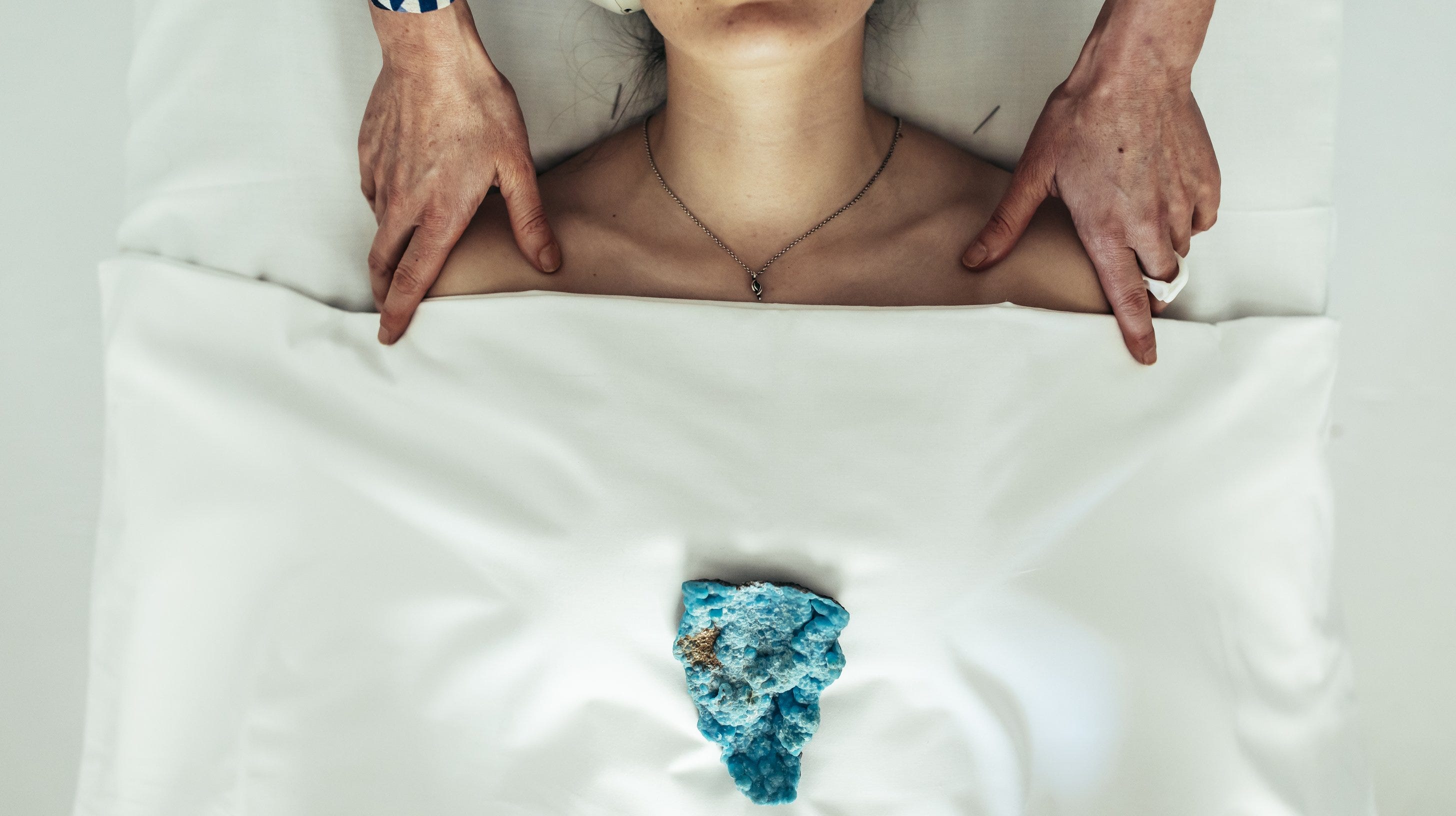
Women come in with fatigue, low back ache, a sense of not quite being held together, the kind of diffuse, unglamorous symptoms that don't get headlines. Sometimes what we're addressing — acupuncture, Kidney support, restoring what menopause has been quietly depleting — is exactly this. Quieter than any headline diagnosis. The slow erosion of Jing that's been going on for years before anyone thought to check.
What strikes me most about my own DEXA result isn't the number. It's that I needed a test to find out at all. We don't feel our bones changing. We don't get symptoms. We get a scan result. Or, eventually, a fracture.
This is not a reason to panic. Early-stage osteopenia, caught early, is something you can genuinely work with. But you have to know first.
So. Here is what I'm doing, and what I'd invite you to consider.
If you're over 40 and haven't had a DEXA scan, get one. Especially if you're in perimenopause or menopause. A baseline gives you information you can actually use. It may not be covered by insurance until age 65, but knowing where you stand now means you can watch the trend, catch changes early, and act when the window is widest.
Move against your bones. Weight-bearing exercise sends the signal that your bones need to stay dense. You don't need to lift heavy. You need to be consistent, and you need load. Resistance training, hiking, dancing, even simple jumping or hopping in place: all of these stimulate bone formation in ways that gentle stretching cannot. (I started hopping in my kitchen every morning. Forty-five seconds.) Muscle talks to bone. Let it.
And if you've been experiencing fatigue, low back ache, memory fog, or disrupted sleep, those symptoms may be speaking the same language in Chinese medicine: Kidney Jing that needs support. There are herbal formulas and acupuncture protocols specific to this, and they work best when addressed proactively, not after a fracture.
Don't wait for bones to become sexy before you take them seriously. They are doing quiet, essential work. They deserve your attention.
Have you had a DEXA scan? If you have, I'd love to know what you found, and what you've done about it. And if you haven't, what's gotten in the way? I waited until 51, so you're in good company either way.
Dr. Catherine
P.S. If you want the full research deep-dive — the science on bone remodeling, myokine signaling, what the evidence actually says about calcium supplementation (spoiler: more complicated than you'd think), and the case for and against HRT for bone health — I wrote about it in detail on the blog.
P.P.S. Know a woman who should be thinking about her bones? Forward this their way.
Such a timely article for me, thank you. I’m recuperating from a broken ankle at age 69 and bone health is suddenly very real. It is a simple break and is healing well; I am very lucky. QiGong and meditation have really been helpful, and so has a more nutritious diet. I’m getting acupuncture tomorrow, and appreciate what you’ve written about kidney energy.